
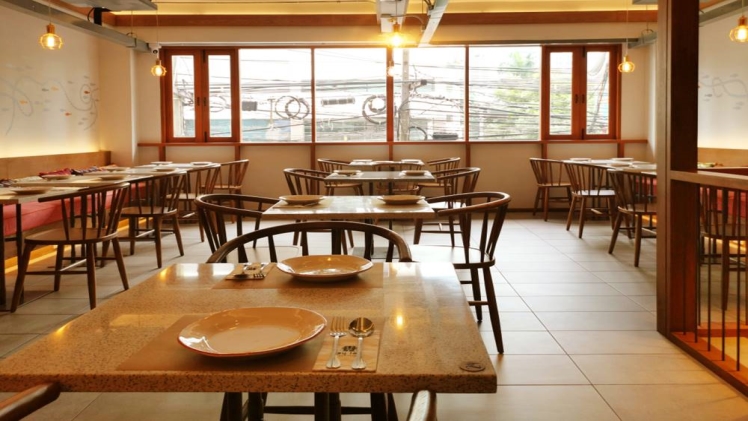
The success of your restaurant is greatly influenced by the tables you choose. It is critical to understand how materials differ in terms of strength, appearance, and cost. Knowing the type of material, composition, aesthetics, and usefulness can help you choose the fabric that will work best for your tables.
Solid wood, laminate, and outdoor table materials comprise the three primary categories of restaurant table tops materials.
-
SOLID WOOD
You may pick from a variety of wood choices for your restaurant table. Different wood species have various aesthetic and practical characteristics. Additionally, some types of wood offer advantages over others. Some varieties of wood are more heat-resistant, stain-resistant, and scratch resistant than others. Hardwood and softwood are the two primary divisions of solid wood.
While softwood makes the table more rustic and affordable, hardwood adds beauty. Hardwood is made from deciduous trees and is often deeper in color than softwood, which is lightweight and comes from coniferous trees.
Every restaurant usually has a dining table as its center point. Thus, you would opt for tables mostly built of hardwood. Most commercial tops are often made of hardwood since it is more durable and has a longer lifespan.
-
LAMINATE
If you want to save money and have more alternatives for customizing your table, laminate is an excellent option for table tops. A laminate layer can be created from synthetic materials to resemble wood, marble, stone, or a single, consistent color. Because laminate is designed to be heat and scratch resistant and because hot things are frequently put on tables, it is the perfect material for use in the food service business.
Not to be confused with melamine, a lower-quality material for home use, laminate is ideal for commercial use. It is constructed of synthetic elements covered in a thin protective coating and may be customized to resemble wood or any other bespoke surface. Laminate is more economical than genuine wood, and it can be tailored in various ways to complement your design. It is excellent for a setting with a lot of traffic since it is incredibly robust and more heat- and scratch-resistant than wood.
Laminate is more sanitary than other surfaces and is simple to maintain and clean. The benefit of laminate is that the top may have any appearance. It ranges from written words and images to stone and wood.
Compared to other materials, laminate is often less costly.
Laminate table tops are simple to maintain and clean. They are more stain resistant and sanitary since they are less absorbent than solid wood.
Laminate is a fantastic material for the restaurant business since it is incredibly durable.
Laminate doesn’t need any special cleaners or polishes and requires little upkeep.
You can make the top layer seem like anything, converting it into a genuine blank canvas for even the craziest decorations.
-
OUTDOOR TABLE MATERIAL
Due to environmental exposure, outdoor tops that are waterproof, rust-proof, and UV resistant are necessary when purchasing patio furniture. Werzalit and plastic teak are common tabletop materials that work well on patios. Both are entirely waterproof and immune to fading brought on by intense UV light.
Plastic teak is a cutting-edge material that imitates natural teak in appearance and feels while being ecologically beneficial. It was first created for nautical usage and is completely waterproof and UV resistant. Werzalit is also composed of a cutting-edge synthetic substance that can resemble a wide range of materials, including wood, marble, printed text, and even printed photographs. Werzalit is waterproof, UV resistant, and scratch-proof, like wood and plastic teak.
