
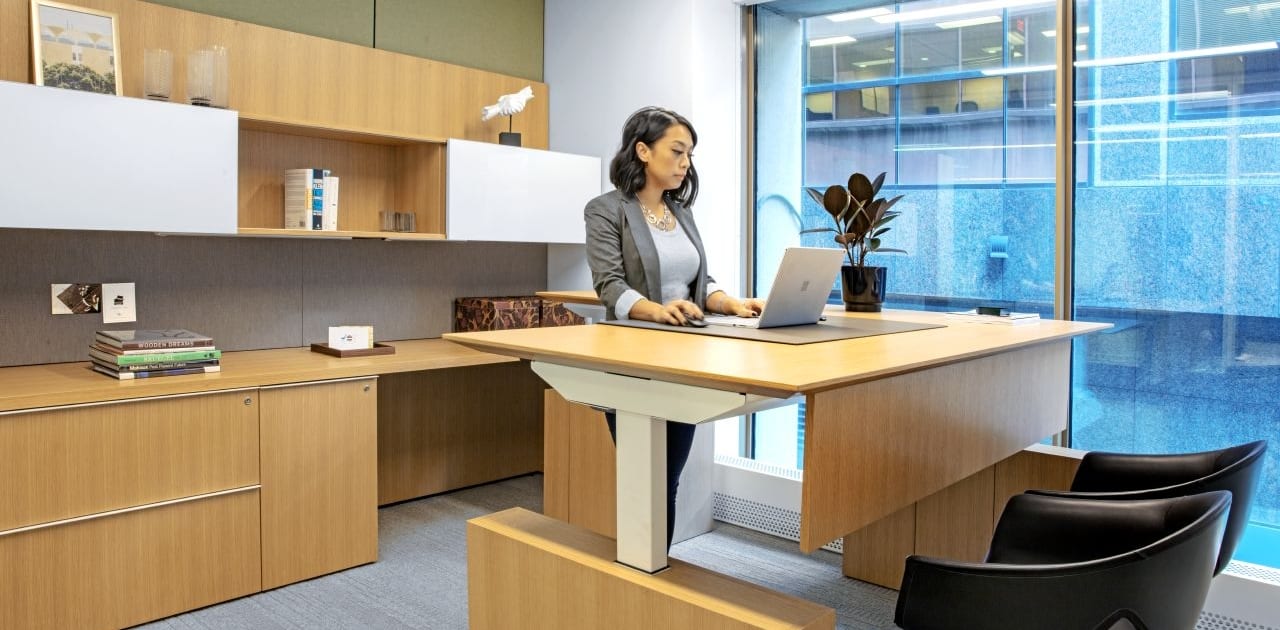
Ergonomics and health-conscious designs play pivotal roles in determining employee well-being and productivity. Among the various ergonomic considerations, the balance between sitting and standing is a significant topic of discussion. What is the optimal ratio for sitting to standing during office hours?
Understanding the Importance of a Balanced Posture
Before delving into the specifics, it’s crucial to underscore why maintaining a proper sitting and standing balance is imperative for modern professionals. Extended periods of sitting have been linked to many health issues, including cardiovascular diseases, obesity, and lower back pain. On the other hand, continuous standing isn’t the solution either, as it can lead to leg pain, cardiovascular problems, and fatigue. Therefore, striking a balance between the two postures is quintessential for health and productivity.
Deciphering the Ideal Ratio
Various studies and ergonomic experts suggest that the ideal sitting-to-standing ratio lies between 1:1 and 1:3. For every hour spent sitting, one should stand for an equivalent duration or up to three times that. Translating this into a typical 8-hour workday:
- Option 1 (1:1): 4 hours of sitting, interspersed with 4 hours of standing.
- Option 2 (1:2): 2.5 hours of sitting and 5 hours of standing.
- Option 3 (1:3): 2 hours of sitting, complemented by 6 hours of standing.
However, these aren’t stringent brackets. Each individual’s comfort and work demands may require tweaks in the above ratios.
Implementing the Sitting-Standing Transition for Workspace Efficiency
1. Transitioning between sitting and standing during office hours is not merely about adhering to the prescribed ratio but ensuring seamless integration into daily routines for maximum benefits. Adopting this balanced posture strategy is pivotal for physiological well-being and cognitive performance. Below, we delve deeper into effective strategies to adopt this approach:
2. Leverage Height-Adjustable Desks: These innovative desks cater to modern professionals’ ergonomic needs. Their easy height-adjustment mechanisms facilitate a swift transition between sitting and standing postures. It can be used as a sitting desk but also as a standing desk. Over time, this feature proves invaluable in maintaining the recommended sit-stand balance without interrupting the workflow.
3. Embrace Technological Aids for Reminders: It’s human nature to get engrossed in tasks and forget to switch postures. By setting regular alarms or using posture-reminder applications, you instill a discipline that breaks monotony and reduces the risks associated with prolonged sitting or standing.
4. Champion the Concept of Active Breaks: Merely standing isn’t enough. Integrating brief activity bursts, be it a stretch, a quick walk, or simple in-place exercises, is beneficial. Such activities invigorate the body, enhance blood flow, and counteract muscle stagnation, leading to increased focus and reduced fatigue.
5. Invest in Ergonomic Enhancements: Accessories play a silent but significant role in posture management. Anti-fatigue mats, designed specifically for standing, reduce pressure on the legs. Similarly, an ergonomic chair, tailored to support spinal curves, ensures that sitting periods don’t compromise posture integrity.
Listening to Your Body: The Ultimate Guide
While the ratios above provide a general guideline, listening to one’s body is paramount. If discomfort or fatigue sets in while following a specific percentage, make necessary adjustments. Some people prefer frequent, shorter switches between postures, while others opt for longer durations. It’s all about individual comfort and ensuring a conducive work environment.
Conclusion: Striking the Balance for Optimal Productivity and Health
The sitting-to-standing ratio is not just about warding off health risks. It’s also about cultivating an office culture that promotes holistic well-being, increasing job satisfaction and enhancing productivity. By understanding the importance of this balance and implementing strategies to achieve it, businesses can pave the way for a healthier, happier, and more productive workforce.
